Artificial Intelligence (AI)
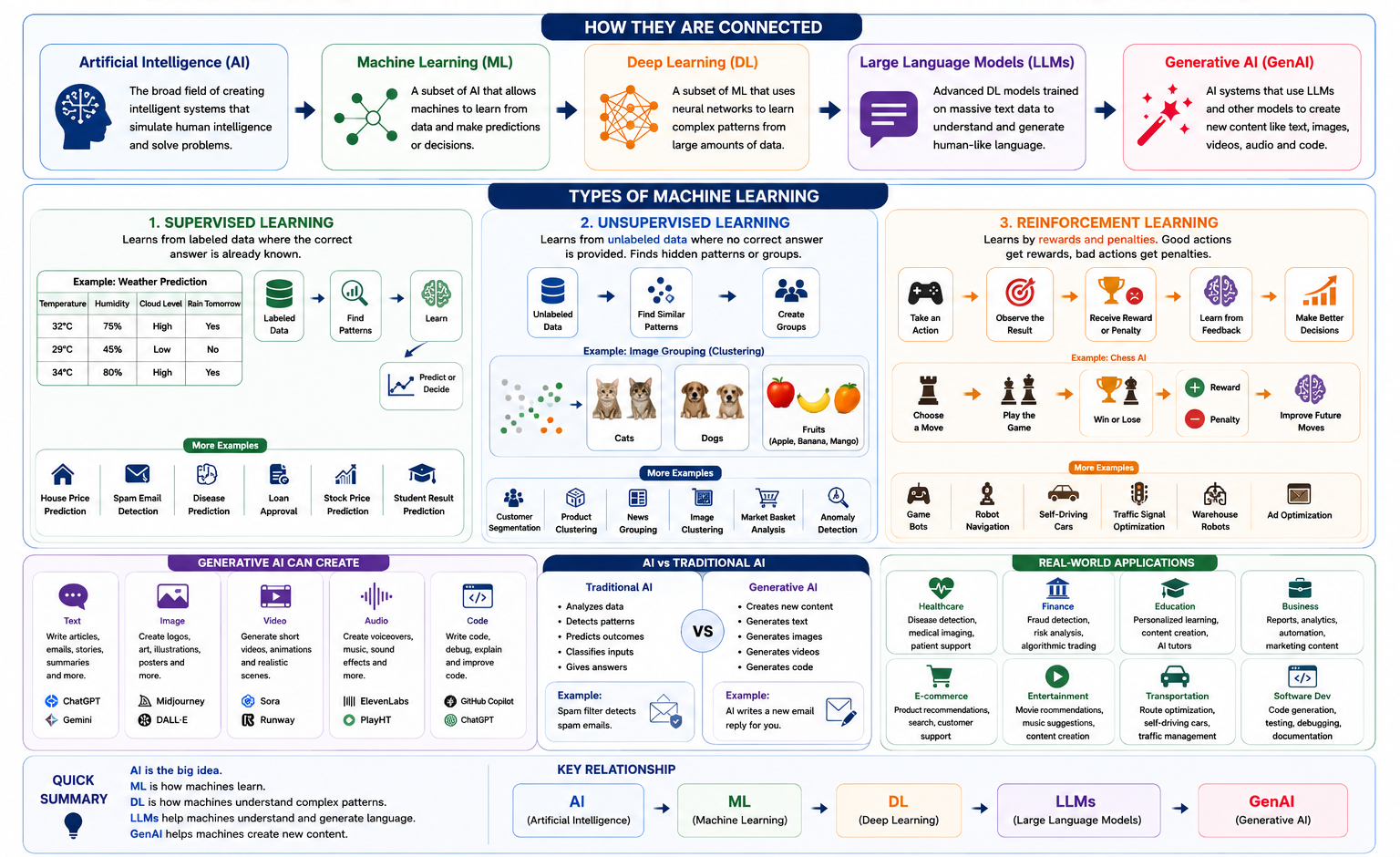
AI is the broad field of building intelligent systems that simulate human intelligence, enabling machines to learn, reason, solve problems, understand language, recognize images, make decisions, and automate tasks.
Machine Learning (ML)
A subset of AI that helps computers learn from data, identify patterns and make predictions without being manually programmed for every situation.
Deep Learning (DL)
An advanced branch of Machine Learning that uses neural networks to understand complex data such as images, speech, text and videos.
Generative AI (GenAI)
A modern form of AI that creates new content such as text, images, videos, audio, software code, presentations and more from user prompts.
Introduction
Artificial Intelligence is already part of our daily life. Google Maps finds the fastest route, Netflix recommends movies, Gmail blocks spam, Face ID unlocks phones, banks detect fraud and ChatGPT writes emails or explains complex topics.
These technologies are connected, but they are not the same. Artificial Intelligence is the broad concept. Machine Learning is a part of AI. Deep Learning is a part of Machine Learning. Large Language Models are built using Deep Learning, and Generative AI uses these models to create new content.
Simple idea: Traditional AI mostly analyzes, predicts or detects. Generative AI creates something new.
How AI, ML, DL, LLMs and Generative AI Are Connected
Artificial Intelligence (AI)
│
├── Machine Learning (ML)
│ ├── Supervised Learning
│ ├── Unsupervised Learning
│ └── Reinforcement Learning
│
├── Deep Learning (DL)
│ ├── Neural Networks
│ ├── Computer Vision
│ ├── Speech Recognition
│ └── Transformers
│
├── Large Language Models (LLMs)
│ ├── GPT
│ ├── Gemini
│ ├── Claude
│ └── Llama
│
└── Generative AI
├── Text Generation
├── Image Generation
├── Video Generation
├── Audio Generation
└── Code Generation
Every Generative AI system is part of Artificial Intelligence, but every AI system is not Generative AI. For example, a spam filter is AI, but it does not create new content. ChatGPT is Generative AI because it creates new text responses from prompts.
What is Artificial Intelligence?
Artificial Intelligence, or AI, is the ability of machines or software systems to perform tasks that normally require human intelligence. These tasks may include understanding language, recognizing images, making decisions, solving problems and automating repetitive work.
Examples of AI
Google Maps, Siri, Alexa, Gmail Spam Filter, Bank Fraud Detection, Chatbots
AI does not mean only robots. Most AI systems today work inside apps, websites, business tools, cameras, banking systems and healthcare platforms.
Myth | Reality |
|---|---|
AI means only robots | Most AI works inside software and digital systems. |
AI will replace every job | AI automates repetitive tasks and helps humans work faster. |
AI is always correct | AI can make mistakes, so human review is important. |
What is Machine Learning?
Machine Learning is a subset of Artificial Intelligence that allows computers to learn from data. Instead of writing every rule manually, we give examples to the machine. The machine studies those examples, finds patterns, and uses those patterns to make predictions or decisions.
Data → Find Patterns → Learn → Predict or Decide → Improve with More Data
Simple Example: Weather Prediction
Suppose we want to predict whether it will rain tomorrow. We can give the machine past weather data such as temperature, humidity, wind speed, cloud level, and previous rainfall information. The machine learns from this data and predicts whether rain is likely or not.
Temperature | Humidity | Cloud Level | Rain Tomorrow |
|---|---|---|---|
32°C | 75% | High | Yes |
29°C | 45% | Low | No |
34°C | 80% | High | Yes |
Here, the answer Rain Tomorrow is already available during training, so the machine learns from known examples.
Types of Machine Learning
Type | Meaning | Simple Example |
|---|---|---|
Supervised Learning | Learns from labeled data, where the correct answer is already known. | Weather prediction, house price prediction, spam detection, disease prediction. |
Unsupervised Learning | Learns from unlabeled data, where no correct answer is provided. The machine finds groups or hidden patterns by itself. | Customer grouping, product clustering, similar news grouping, image grouping. |
Reinforcement Learning | Learns by rewards and penalties. Good actions receive rewards, and wrong actions receive penalties. | Chess AI, game bots, robot movement, traffic signal optimization. |
1. Supervised Learning: Learning With Correct Answers
Supervised Learning is like learning with a teacher. The machine receives both the question and the correct answer. It studies many examples and learns how to predict the answer for new data.
Easy meaning: Supervised Learning means the machine learns from data where the correct answer is already given.
Example: Weather Prediction
In weather prediction, the model may receive past weather data along with the actual result: whether it rained or not. Because the correct result is already provided, this is supervised learning.
Input Data | Correct Answer |
|---|---|
High humidity + dark clouds + low pressure | Rain |
Low humidity + clear sky + normal pressure | No Rain |
High temperature + high humidity + cloudy sky | Rain Possible |
More Supervised Learning Examples
House Price Prediction: Predicting price using size, location, rooms, and past sale prices.
Email Spam Detection: Learning from emails already marked as spam or not spam.
Disease Prediction: Learning from patient records where the diagnosis is already known.
Loan Approval: Learning from past approved and rejected loan applications.
Student Result Prediction: Predicting marks using attendance, previous scores, and study hours.
2. Unsupervised Learning: Finding Hidden Patterns
Unsupervised Learning is like learning without a teacher. The machine receives data, but no correct answer is provided. It studies the data and finds groups, similarities, or hidden patterns on its own.
Easy meaning: Unsupervised Learning means the machine gets unlabeled data and finds patterns by itself.
What is Labeled and Unlabeled Data?
Data Type | Meaning | Simple Example |
|---|---|---|
Labeled Data | Data where the correct answer is already given. | Email marked as Spam or Not Spam. |
Unlabeled Data | Data where the correct answer or category is not given. | Customer purchase history without any customer category. |
Example: Customer Grouping
Suppose an online store has thousands of customers. The business may not know which customers are budget buyers, premium buyers, or frequent buyers. An unsupervised learning model can study customer behavior and automatically create groups.
Customer Purchase Data → Identify Similar Shopping Patterns → Group Similar Customers → Budget Buyers | Premium Buyers | Frequent Buyers | Occasional Buyers
More Unsupervised Learning Examples
Customer Segmentation: Grouping customers based on buying behavior.
Product Clustering: Grouping similar products together.
News Grouping: Grouping similar news articles automatically.
Image Grouping: Grouping similar images without predefined labels.
Fraud Pattern Discovery: Finding unusual patterns in transactions.
3. Reinforcement Learning: Learning From Rewards
Reinforcement Learning is like learning by practice. The system tries an action, observes the result, and receives a reward or penalty. Over time, it learns which actions are better.
Easy meaning: Reinforcement Learning means the machine learns from experience, rewards, and penalties.
Example: Chess AI
A chess AI tries different moves. If a move improves its chance of winning, it receives a positive reward. If a move causes loss, it receives a penalty. After many games, the AI learns better strategies.
Take an Action → Observe the Result → Receive Reward or Penalty → Learn from Feedback → Make a Better Decision Next Time
More Reinforcement Learning Examples
Chess AI: Learning better moves through wins and losses.
Game Bots: Learning strategies by playing again and again.
Robot Movement: Learning how to walk, move, or pick objects.
Self-Driving Cars: Learning safe driving decisions in simulated environments.
Traffic Signal Optimization: Learning how to reduce waiting time at signals.
Machine Learning Type | Easy Memory Trick |
|---|---|
Supervised Learning | Learning with a teacher because correct answers are provided. |
Unsupervised Learning | Learning without a teacher because the machine finds patterns itself. |
Reinforcement Learning | Learning by experience because rewards and penalties guide the machine. |
What is Deep Learning?
Deep Learning is an advanced branch of Machine Learning that uses artificial neural networks to learn complex patterns from large amounts of data.
Imagine a child learning to recognize a face. First, the child notices eyes, nose, mouth and ears. Then the child combines these features and understands that it is a face. Deep Learning works in a similar layered way.
Pixels
↓
Edges
↓
Shapes
↓
Eyes, Nose, Mouth
↓
Face
↓
Person Identity
Examples of Deep Learning
Face ID on smartphones
Speech recognition
Self-driving cars
Medical scan analysis
OCR text reading from images
Language translation
What are Large Language Models?
Large Language Models, or LLMs, are advanced AI models trained on massive amounts of text data. They can understand, summarize, translate, write and answer questions in human-like language.
LLMs are built using Deep Learning techniques, especially transformer-based neural networks. They power tools like ChatGPT, Gemini, Claude and Llama.
What LLMs Can Do
Write articles and emails
Explain technical concepts
Generate software code
Summarize long documents
Translate languages
Answer questions
What is Generative AI?
Generative AI is a type of Artificial Intelligence that can create new content based on user instructions, also called prompts.
Traditional AI mainly analyzes, classifies, predicts or detects. Generative AI creates.
Traditional AI | Generative AI |
|---|---|
Detects spam emails | Writes a new email reply |
Identifies a face in an image | Creates a new image from a prompt |
Predicts customer behavior | Creates marketing copy or product descriptions |
What Can Generative AI Create?
Prompt | Generated Output | Example Tool |
|---|---|---|
Write a blog post | Text | ChatGPT, Gemini, Claude |
Create a logo | Image | Midjourney, DALL-E |
Create a product video | Video | Sora, Runway |
Write software code | Code | GitHub Copilot, ChatGPT, Claude |
Create a voiceover | Audio | ElevenLabs |
AI vs ML vs DL vs Generative AI: Complete Comparison
Feature | AI | ML | DL | Generative AI |
|---|---|---|---|---|
Meaning | Machines performing intelligent tasks | Machines learning from data | Machines using neural networks | Machines creating new content |
Main Goal | Decision-making and automation | Prediction and pattern learning | Complex pattern recognition | Text, image, video, audio and code generation |
Example | Google Maps | Netflix recommendation | Face ID | ChatGPT, Midjourney |
Real-World Examples
Area | AI / ML / DL Use | Generative AI Use |
|---|---|---|
Spam detection and email sorting | Writing email replies and summaries | |
Healthcare | Disease prediction and medical scan analysis | Creating patient summaries and educational content |
Software Development | Bug detection and code analysis | Writing code, tests and documentation |
Education | Personalized learning recommendations | Generating notes, quizzes and explanations |
Business | Sales prediction and customer insights | Creating reports, emails, ads and presentations |
Challenges and Best Practices
AI and Generative AI are powerful, but they are not perfect. They can make mistakes, produce biased results or generate confident but incorrect information. This is why human review is important.
Best Practices
Use AI as an assistant, not as the final authority.
Verify important information before using it.
Do not share confidential data with public AI tools.
Write clear and specific prompts.
Review AI-generated content before publishing.
Combine human judgment with AI speed.
Conclusion
Artificial Intelligence, Machine Learning, Deep Learning, Large Language Models and Generative AI are closely connected, but each has a different role.
Artificial Intelligence is the broad field of making machines intelligent. Machine Learning allows machines to learn from data. Deep Learning uses neural networks to understand complex patterns. Large Language Models understand and generate language. Generative AI creates new content such as text, images, videos, audio and code.
AI is the big idea.
Machine Learning is how machines learn.
Deep Learning is how machines understand complex patterns.
LLMs help machines understand and generate language.
Generative AI helps machines create new content.
AI is already transforming education, healthcare, business, finance, entertainment and software development. The goal is not to fear AI, but to understand it and use it responsibly.