What is an API?
API stands for Application Programming Interface. It is a mechanism that allows two different software systems to communicate with each other in a structured and secure way.
APIs act like bridges between applications. One system sends a request, and another system processes that request and returns a response.
Simple Real-World Example:
When you book a cab through a mobile application, the platform may use:
Google Maps API for live location tracking
Payment API for transaction processing
SMS API for notifications
Authentication API for login verification
Why APIs are Important
Accelerate software development
Enable integration between applications
Support cloud and mobile applications
Allow secure data exchange
Reduce development complexity
Improve scalability and flexibility
Enable automation and interoperability
Support microservices architecture
How APIs Work
APIs generally work using a request-response model.
StepDescription1Client sends a request to the API2Server processes the request3API returns the response
Example API Request
GET https://api.example.com/users
Example JSON Response
{
"id": 1,
"name": "John Tyagi",
"email": "john@example.com",
"role": "Developer"
}
API Architecture and Communication Flow
Modern APIs are commonly built using scalable and distributed architectures.
Client Application
↓
API Gateway
↓
Authentication Layer
↓
Business Logic / Microservices
↓
Database
↓
Response Returned to Client
This layered architecture improves scalability, security and maintainability.
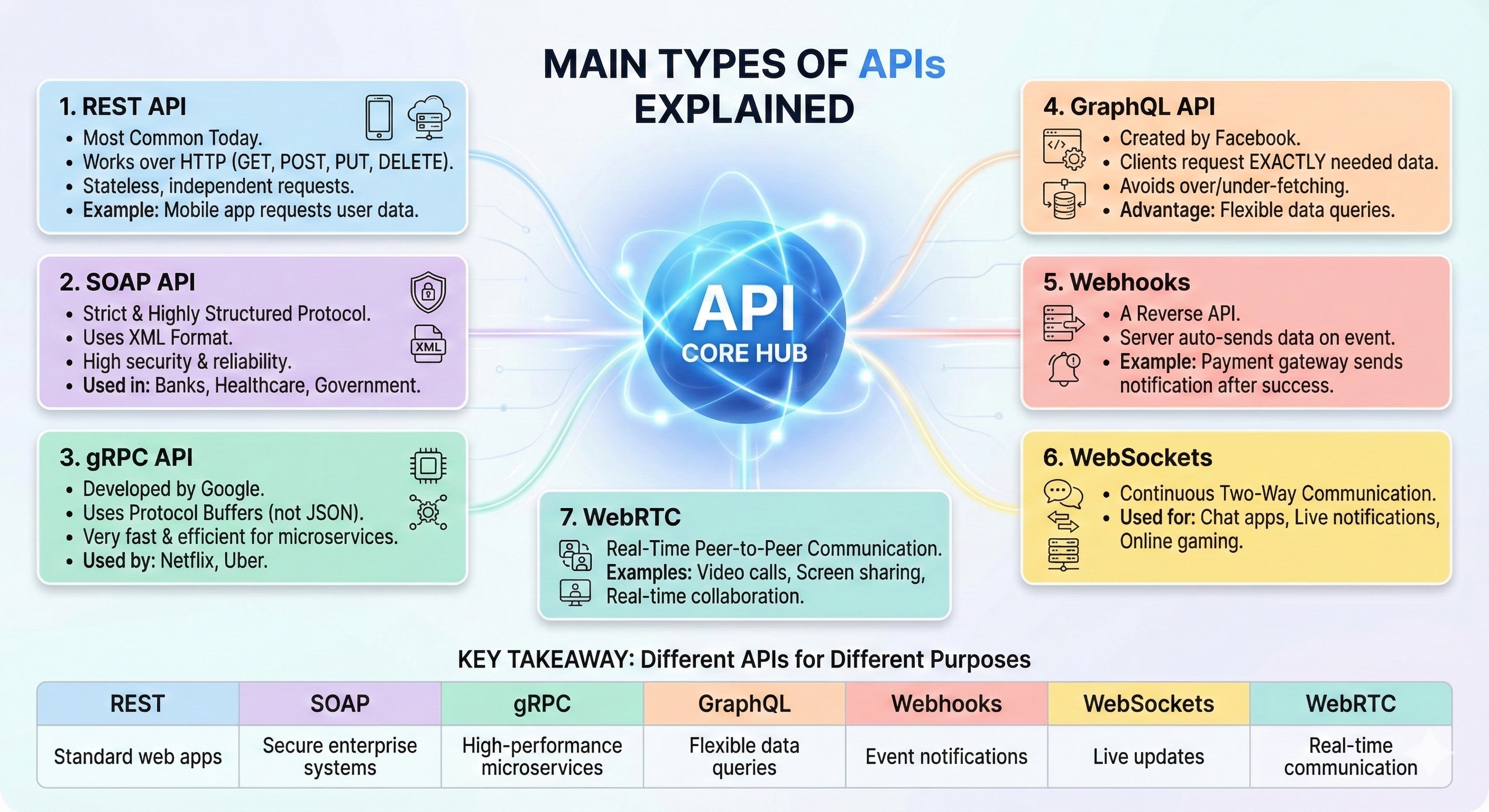
Types of APIs
1. REST API
REST APIs are the most widely used APIs today. They work over HTTP and usually exchange data using JSON format.
2. SOAP API
SOAP APIs use XML messaging and are commonly used in enterprise, banking and legacy systems.
3. GraphQL API
GraphQL allows clients to request only the required data, improving performance and flexibility.
4. Webhooks
Webhooks automatically send data when specific events occur.
5. gRPC APIs
gRPC is a high-performance API framework developed by Google for efficient microservices communication.
HTTP Methods Used in APIs
Method: Purpose
GET: Retrieve data
POST: Create new data
PUT: Update existing data
PATCH: Partial update
DELETE: Remove data
REST API CRUD Example
ActionMethodEndpoint
Get Users - GET - /users
Create User - POST - /users
Update User - PUT - /users/1
Delete User - DELETE - /users/1
HTTP Status Codes
Status - CodeMeaning
200 - Success
201 - Created Successfully
400 - Bad Request
401 - Unauthorized
403 - Forbidden
404 - Resource Not Found
500 - Internal Server Error
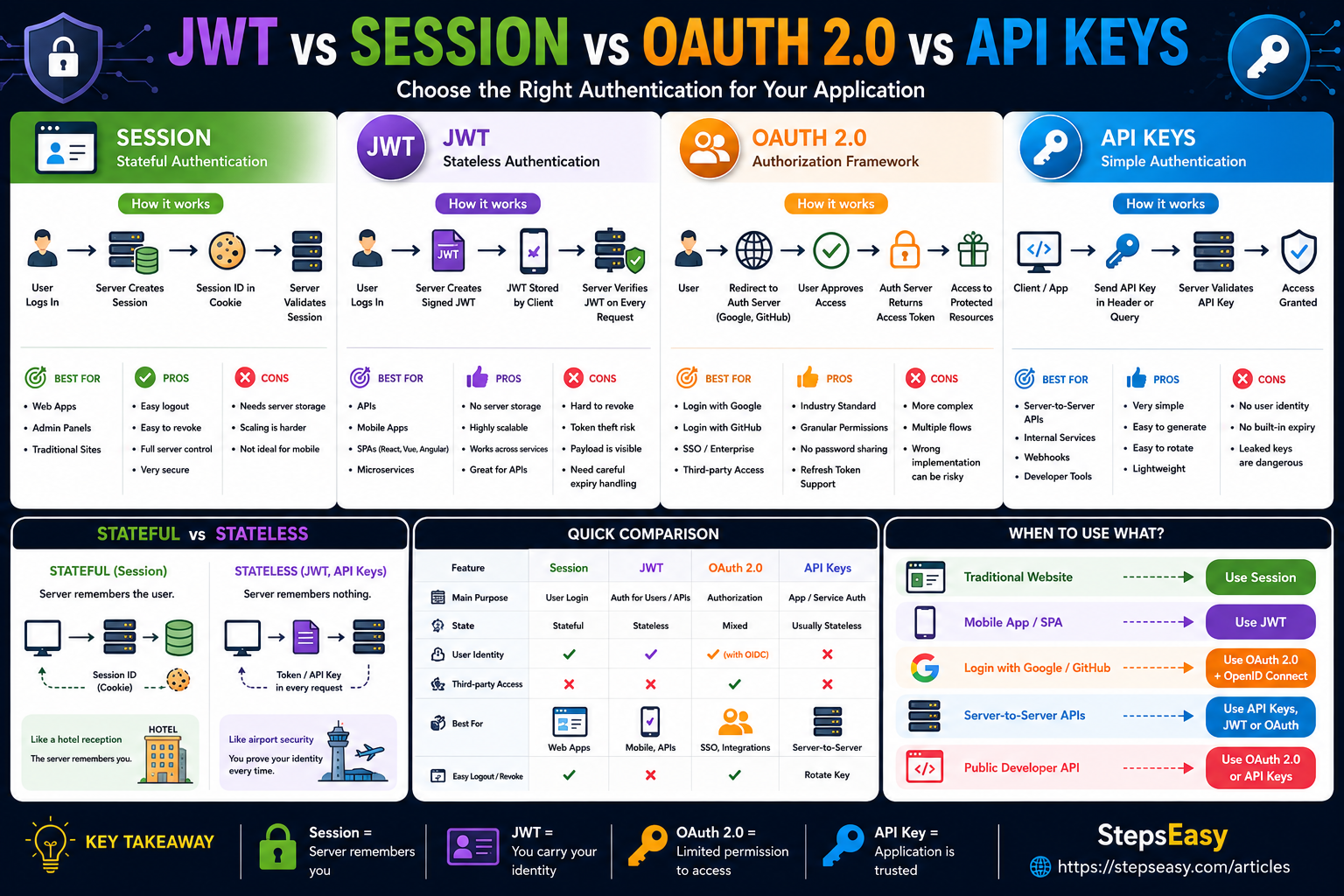
API Authentication and Authorization
APIs use authentication and authorization mechanisms to protect systems and sensitive data.
API Keys
Bearer Tokens
JWT Authentication
OAuth 2.0
Session-Based Authentication
API Security Best Practices
Always use HTTPS
Validate incoming data
Implement rate limiting
Protect against SQL Injection
Enable token expiration
Implement authentication and authorization
Monitor and log API traffic
Use API gateways and firewalls
Public APIs vs Private APIs
API Type - Description
Public API - Available for external developers
Private API - Used internally within organizations
Partner API - Shared with specific business partners
Composite API - Combines multiple APIs into a single request
API vs Web Service
APIWeb Service
Broader concept - Subset of APIs
Can use multiple protocols - Usually uses HTTP/XML
May work locally - Works over network
Popular API Testing Tools
Postman
Swagger
Insomnia
cURL
Hoppscotch
Real-World Applications of APIs
Payment Gateways
E-Commerce Platforms
Cloud Infrastructure
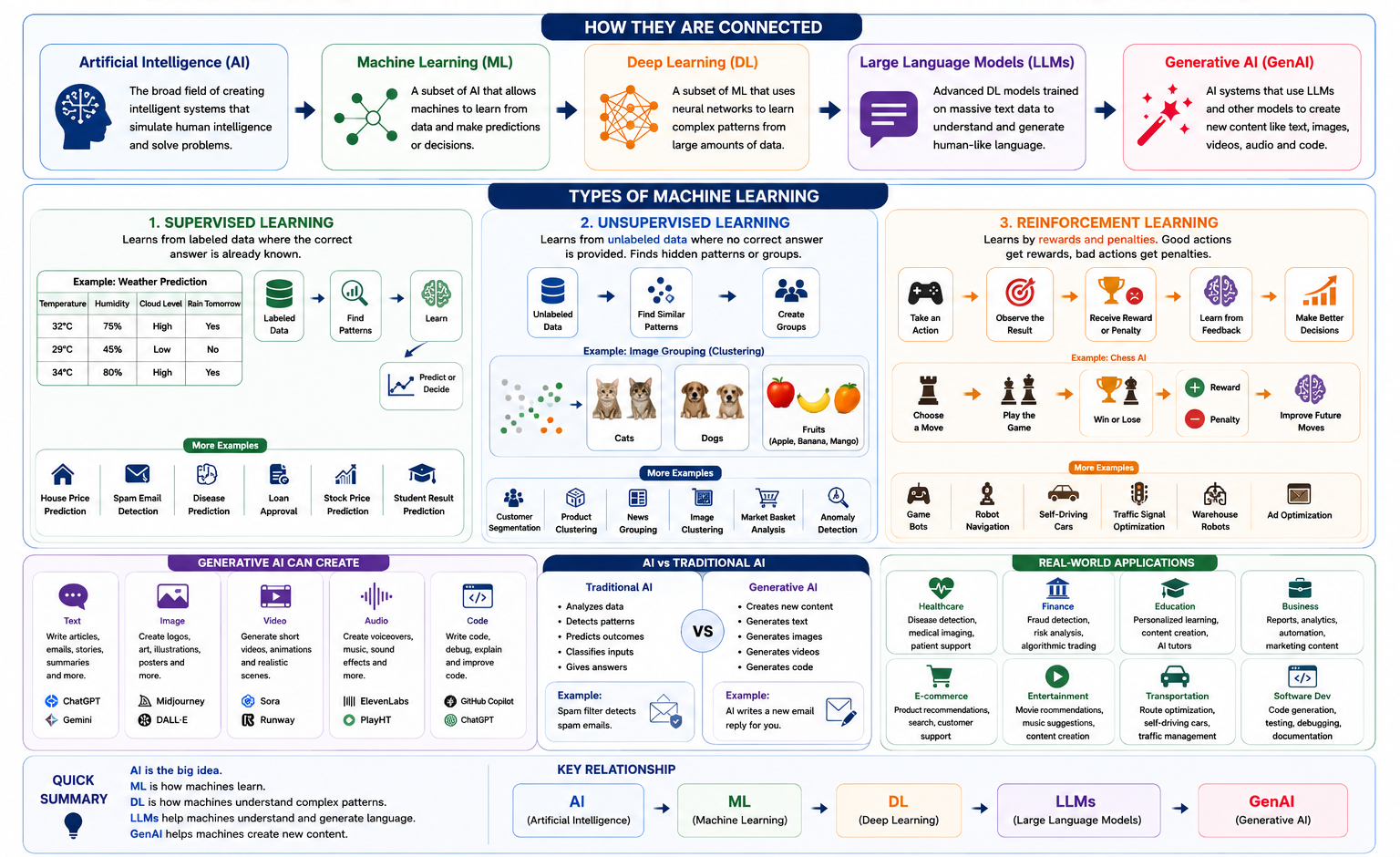
Artificial Intelligence Systems
Healthcare Applications
Logistics and Tracking
Social Media Integrations
Banking and Financial Systems
IoT and Smart Devices
Modern API Trends
AI and Machine Learning APIs
Cloud-Native APIs
Serverless APIs
GraphQL Adoption
API-First Development
Microservices-Based APIs
Real-Time APIs
Conclusion
APIs are among the most important technologies in modern software development. They allow systems, applications and services to communicate efficiently across platforms and environments.
Whether building a mobile application, enterprise platform, SaaS product, cloud infrastructure, AI solution, healthcare platform or automation system, APIs play a central role in integration, scalability and digital transformation.
Understanding APIs is now a fundamental skill for developers, architects, DevOps engineers, cloud professionals and technology leaders.